

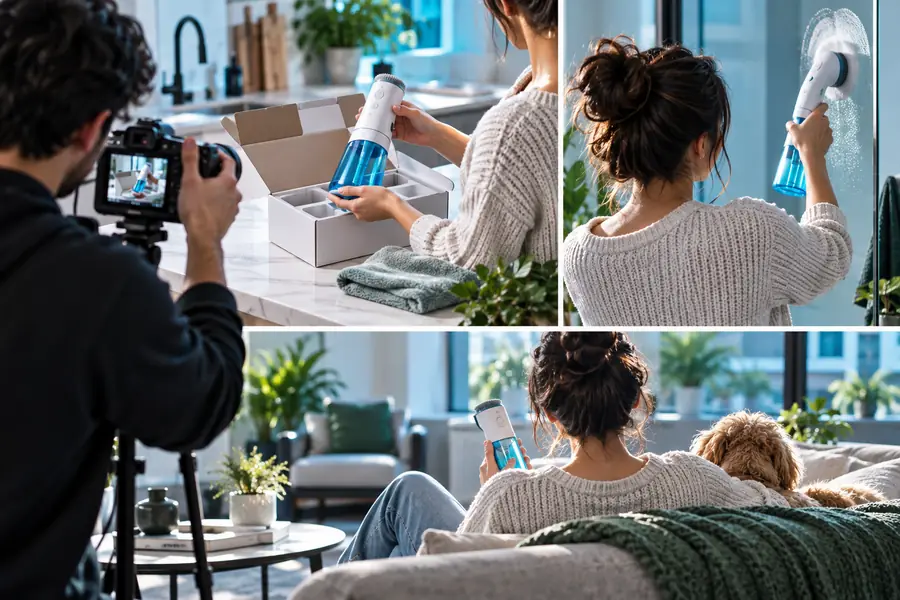
Review video workflow

arcads for reviews that feel human

Arcads for reviews gives teams a practical way to move from scattered customer feedback to focused video concepts. Use the workflow to clarify the proof, shape the message, and create review-led creative with a consistent point of view.

AI-generated creator presenting a product in a warm studio setting

The core value

Turn customer feedback into usable creative

The strongest review videos do more than repeat a compliment. They connect a specific customer problem to a visible outcome, then present that story in a format people can quickly understand.

  1. 1

    Collect the proof

    Pull out the exact phrases, objections, and outcomes that make a review credible. Separate specific evidence from broad praise so the creative has something concrete to show.

  2. 2

    Shape the story

    Organize the feedback into a simple arc: the situation before, the change that mattered, and the reason someone else should care. Keep the language close to the customer’s natural voice.

  3. 3

    Create the visual brief

    Translate the story into a presenter, setting, product moment, and opening line. A clear brief gives the video a job instead of asking it to communicate every benefit at once.

  4. 4

    Review and refine

    Check whether the finished concept still reflects the original evidence. Tighten claims, remove vague language, and prepare alternate openings when the same review supports more than one angle.

Useful next steps

Related Arcads workflows

Review content often sits inside a larger creative process. These nearby pages help you move from the core idea to the format, angle, or comparison that fits the project.

A useful distinction

Review evidence versus finished video

A review is source material; a video is an interpretation of that material. Keeping the two separate helps you preserve trust while making the story easier to watch and remember.

Customer review source
Review-led video output

Primary job

Customer review source

Record what a customer experienced

Review-led video output

Make the experience easy for a new viewer to understand

Language

Customer review source

Often detailed, spontaneous, and uneven

Review-led video output

Edited into a focused, natural-sounding narrative

Proof

Customer review source

Specific details, outcomes, and personal context

Review-led video output

Selected details paired with a clear visual demonstration

Structure

Customer review source

May begin in the middle of the story

Review-led video output

Usually benefits from a clear problem, change, and result sequence

Visual role

Customer review source

The text or recording carries most of the meaning

Review-led video output

Presenter, product, setting, and action reinforce the claim

Best use

Customer review source

Research, validation, and message discovery

Review-led video output

Paid creative, landing-page support, and social testing

Main risk

Customer review source

Important evidence can be buried in extra detail

Review-led video output

Polish can make a claim sound stronger than the source supports

See the transformation

From raw review to visual proof

The before-and-after distinction is not about changing what the customer said. It is about giving the useful part of the story a clearer setting, sequence, and visual focus.

Review-focused creative brief and source material Raw review input
Creator presenting a polished wellness product review Visual review concept
Keep the claim anchored to the source review.

Where it fits

Review creative for different teams

The same review can support different creative jobs. Start with the audience, the proof they need, and the decision the video should help them make.

Growth marketer

You have several positive reviews but need distinct angles for testing instead of one generic testimonial.

Build separate concepts around the strongest pain points, outcomes, and objections in the source material.

arcads hook generator

Product marketer

A launch page needs customer language that explains why the product matters without sounding like a feature list.

Turn specific review details into a concise story that connects the product experience to a clear use case.

arcads ai video

Community manager

You want to reuse authentic customer language in a channel where overly polished promotion can feel out of place.

Keep the conversational point of view while adapting the structure for a community-aware review video.

arcads for reddit

Small business owner

You know which customers are happiest but do not have a repeatable way to turn their feedback into creative.

Use a simple evidence-to-brief process so each review becomes a focused opportunity rather than an isolated quote.

arcads alternative

Put reviews to work

Make your next review easier to activate

Start with one customer story and define the proof before you worry about polish. A focused brief can reveal the right presenter, setting, opening line, and outcome for the video, while a careful review keeps the final message aligned with what the customer actually experienced.

Create review creative
  • Begin with one specific customer outcome
  • Keep the original evidence visible during editing
  • Test the message before expanding the production brief

Common questions

arcads for reviews FAQ

These answers focus on the planning decisions that make review-led video clearer, more credible, and easier to evaluate.

It means using Arcads as part of a workflow for turning customer feedback into focused video concepts. The useful work happens before production: identify the strongest evidence, define the audience, and decide what the video should help that audience understand.

Choose a review with a specific situation, a recognizable problem, and a clear change or outcome. Concrete details are usually more useful than broad praise because they give the script and visuals something meaningful to communicate.

Keep the important facts and distinctive point of view faithful to the source. You can shorten repetition and improve structure, but avoid adding results, promises, or product experiences that the original review does not support.

Yes, when the review contains several legitimate angles, such as different use cases, objections, or outcomes. Create separate concepts only when each one has its own clear audience and message; otherwise, splitting the story can weaken the proof.

Check that the wording matches the source, the product is represented accurately, and the visual treatment does not imply evidence that was never provided. Also review whether the opening makes the customer problem clear without overstating the result.

Start creating
Start creating